
Last updated October 15, 2026
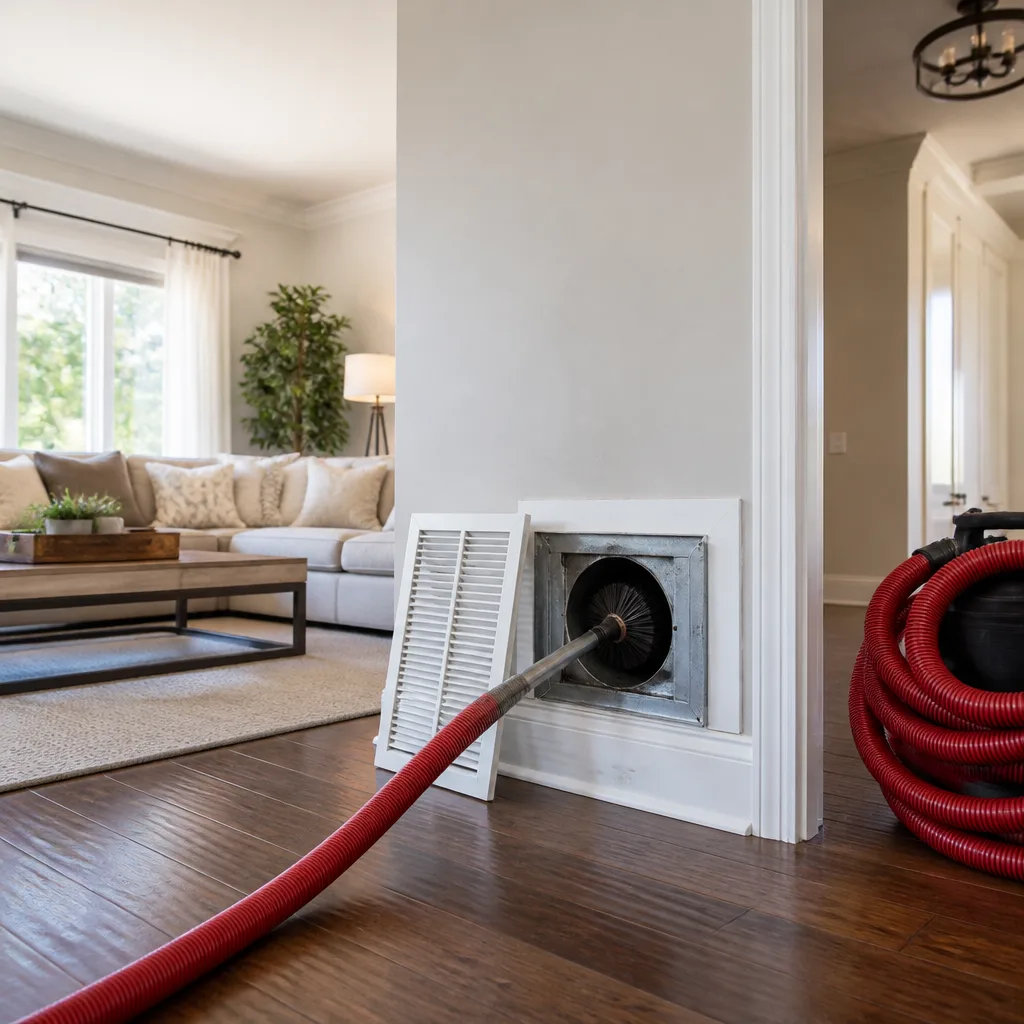 Whole-home duct cleaning
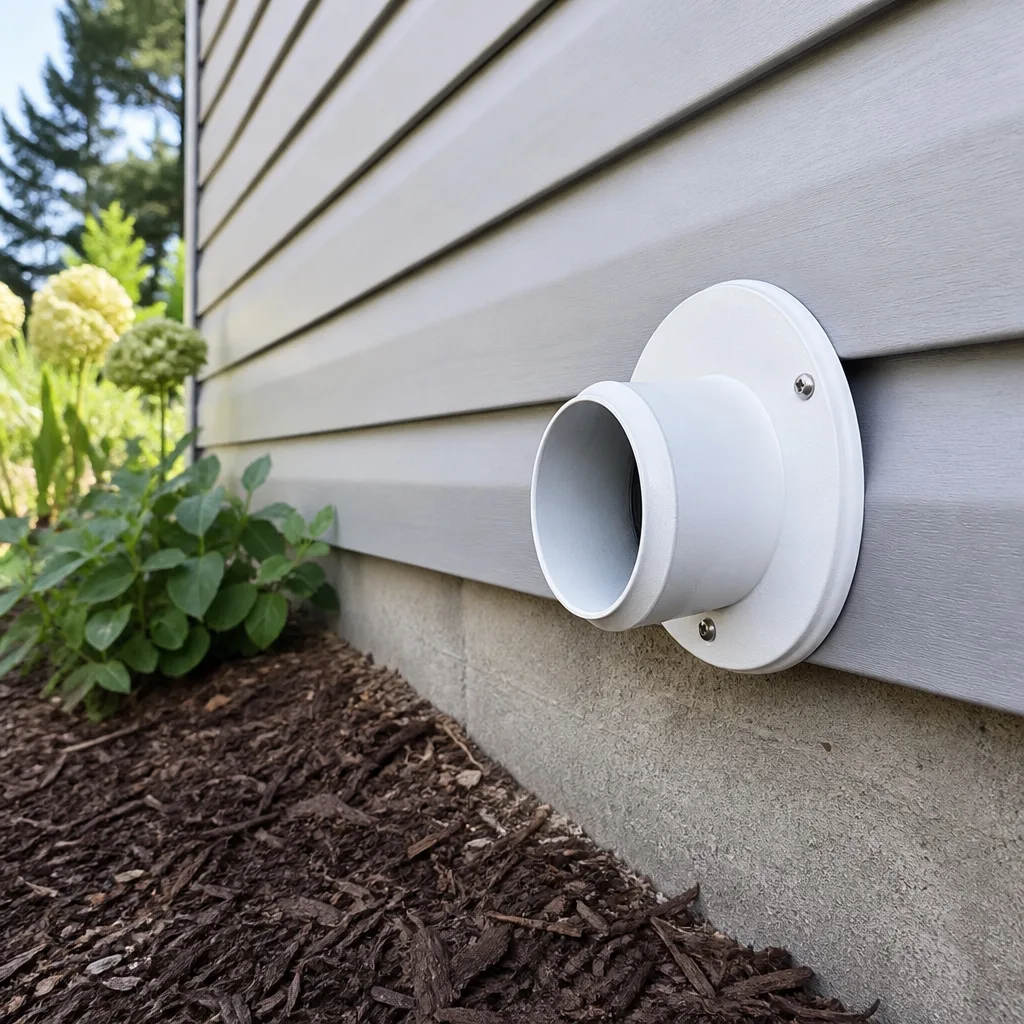 Dryer vent cleaning
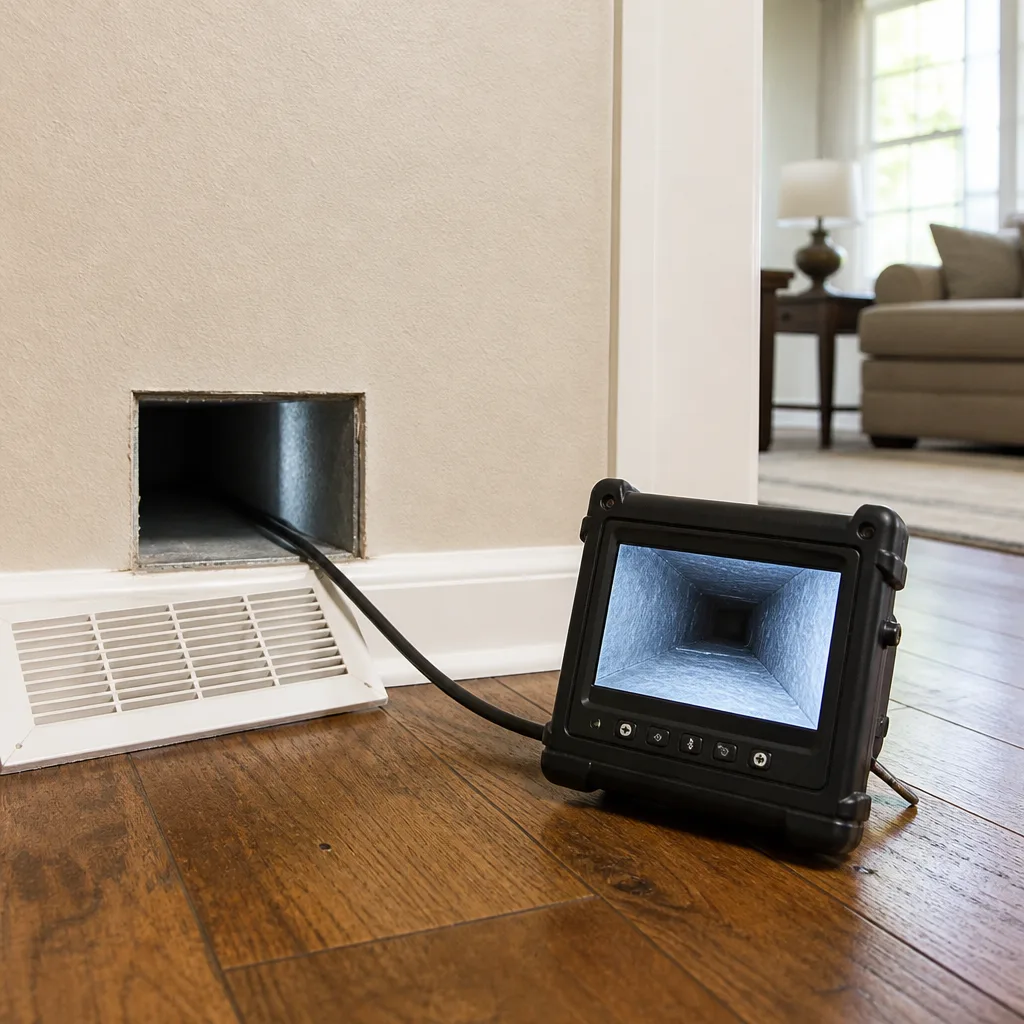 Camera inspection
 Sanitizing & deodorizing
Whole-system duct and dryer vent check with before-and-after photos - you see exactly what came out of your vents
That "$99 whole-house special" is a bait ad - the real number appears once they are in your hallway, or the "clean" is a shop-vac at the register. We photograph the inside of your ducts before and after instead.
DIY vs Professional Air Duct Cleaning: The Austin Homeowner’s Decision Guide
A shop vac aimed at a register face does roughly 4% of what a truck-mounted negative-pressure system accomplishes at the same spot. Not because the homeowner lacks effort. The physics are simply different. This guide maps the exact line between what you can reasonably do yourself in Austin and what genuinely requires our Air Duct Cleaning services, so you can decide with your eyes open instead of your fingers crossed.
Styles & brands we work with
Quick Answer
DIY air duct cleaning in Austin works for what your arm can reach: register faces, return grilles, filter replacement, and camera-assisted visual inspection. What it cannot do is extract the debris packed deep inside the duct runs, because that requires negative-pressure airflow at volumes a shop vac will never generate. If your system hasn’t been professionally cleaned in five or more years, has visible mold, or has been through a renovation, the DIY route leaves the actual problem untouched.
Table of Contents
- What DIY Duct Cleaning Can Actually Accomplish
- The Equipment Gap: Why Negative Pressure Matters
- DIY Observation: Using Your Phone Camera as a Diagnostic Tool
- Cost-Benefit: Three Years of DIY vs One Professional Cleaning
- Austin-Specific Conditions That Change the Calculus
- When DIY Makes Sense, and When It Doesn’t
- How Professional Air Duct Cleaning Actually Works
- Common Mistakes to Avoid
- When to Call a Professional
- Frequently Asked Questions
- The Bottom Line
What DIY Duct Cleaning Can Actually Accomplish
Let’s be honest about what a Saturday afternoon and a decent shop vac will get you in an Austin home. Register faces collect dust because they are the last physical surface before air enters your living space. Cleaning them is real work with a real benefit. The same goes for return grilles, which act as the system’s intake and gather lint, pet hair, and that fine gray dust Austin’s dry spells kick up.
Here is what we tell Austin homeowners is legitimately worth their time:
- Register face cleaning: Remove each register, wipe or vacuum both sides, and you’ve eliminated the visible dust that made you think about duct cleaning in the first place. This takes maybe an hour for a 2,000-square-foot house.
- Return grille cleaning: The large grille on your wall or ceiling is where your filter lives. The area behind it collects a filter-shaped rectangle of grime that you can and should clean regularly.
- Filter replacement: This is the single highest-impact DIY task in your HVAC system. In Austin, with our long cooling season, a pleated filter should be changed every 60 to 90 days, more often if you have pets or live near construction.
- Visual inspection with your phone camera: Stick your phone into a register boot, aim upward with the flash on, and take a photo. You’ll see dust accumulation, loose debris, or nothing at all. This is diagnostic information, not cleaning, but it tells you what you’re dealing with.
None of these tasks moves debris out of the duct runs themselves. That’s fine, so long as you understand the distinction. A clean register face attached to a dusty duct system is like washing your car’s mirrors while the rest of the vehicle stays dirty. You’ve improved something, and the mirror matters, but the car is still dirty.
The Equipment Gap: Why Negative Pressure Matters
Professional air duct cleaning in Austin works on a principle most people never think about: you cannot clean a duct by blowing air into it. You can only clean it by pulling air through it at sufficient volume to overcome the static pressure of the entire duct run, every bend, every transition, every register boot. That requires negative pressure.
A truck-mounted unit or a large portable unit from brands like Rotobrush or Nikro generates airflow measured in thousands of cubic feet per minute. A good shop vac generates roughly 100 to 200 CFM. The duct system in an average Austin home, with its long runs through hot attics and tight chases, presents resistance that a shop vac cannot overcome. The air simply won’t move fast enough to dislodge anything except what happens to be loose directly at the register opening.
What happens when you try anyway is instructive. Any debris you do manage to knock loose travels a short distance and then settles back down, often deeper in the run than where it started. Without a collection system capturing what you dislodge, you redistribute dust through your house rather than removing it. The blower in your HVAC system then spreads that freshly loosened particulate through every room in the Austin heat, when windows are closed and the AC runs for ten months of the year.
Negative-pressure extraction matters because it establishes airflow direction. The professional system seals the duct run, creates negative pressure from one end, and mechanically agitates the interior walls from the other. Every particle knocked loose gets pulled toward the collection point. No particle re-enters the living space. That is the physical difference between cleaning and rearranging.
DIY Observation: Using Your Phone Camera as a Diagnostic Tool
Your phone camera is the single best DIY tool you own for duct assessment, and it costs nothing beyond what you paid for the phone. We recommend Austin homeowners do this before scheduling anything, including with us. For How to Hire a Air Duct Cleaning Contractor in Austin: A Step-by-Step Guide, an informed decision is better than a rushed one.
Here is the diagnostic sequence we suggest:
- Photograph the return grille before removing it. Note the dust pattern. A uniform light coating is normal. Thick, dark accumulation that looks like felt means the filter has been bypassing air or hasn’t been changed in months.
- Remove the filter and photograph the filter slot. Look for dust trails around the filter edges. Those trails indicate air bypassing the filter, which means unfiltered air has been circulating through your system and accumulating in the ductwork.
- Remove a supply register in a far room. Insert your phone, flash on, and photograph the boot and the first few inches of duct you can see. A thin film of dust is normal. Clumps, visible debris, or anything that looks like construction dust is not.
- Check a second register near the air handler. Compare the two. Heavier accumulation far from the handler is common, because airflow slows at the end of long runs and particles drop out of suspension.
- Look for signs of moisture. Rust spots, water stains, or dark discoloration on the duct walls are not a cleaning issue. They are a moisture issue that needs to be diagnosed separately.
This sequence takes twenty minutes and tells you what you’re actually working with. The photos also give you something concrete to discuss with any professional you call, and they prevent the “your ducts are terrible, good thing you called us” sales pitch that depends on you not having looked.
Cost-Benefit: Three Years of DIY vs One Professional Cleaning
Let’s put real numbers on the table, because the DIY-versus-professional decision is ultimately a financial one for most Austin homeowners. These are market ranges for our area, not national averages.
- HEPA-equipped shop vac: $120 to $250, one-time purchase. The HEPA filter itself costs $30 to $50 and needs replacement roughly annually if you’re using the vac regularly.
- Vent-cleaning brush kits: $25 to $60. These extend to perhaps 15 feet and clean the first few feet of a duct run near the register.
- High-quality pleated filters: $12 to $20 each, changed every 2 to 3 months. That’s $50 to $120 per year if you’re diligent.
- Total three-year DIY investment: roughly $300 to $550, depending on what you buy and how often you replace filters.
A professional whole-system cleaning for a typical Austin single-family home runs $400 to $650, depending on the number of returns and system configuration. So the out-of-pocket costs are broadly comparable over three years. What differs is the outcome.
After three years of diligent DIY, you will have clean register faces, clean grilles, fresh filters, and a duct system that has continued accumulating whatever was in it before, plus three more years of dust, at the same rate. After one professional cleaning, the entire system starts from zero. The comparison isn’t really about money. It’s about what the money reaches.
We tell Austin homeowners this plainly: if your duct system is in reasonably clean condition, DIY maintenance will keep it that way for years. If it’s not clean, DIY tools will not make it clean. They will make the visible parts look better while the actual ducts remain untouched, and you’ll spend the same money the professional cleaning would have cost without getting the professional result.
Austin-Specific Conditions That Change the Calculus
Austin is not a generic market. The conditions here are specific and they affect what accumulates in your ducts, how fast it accumulates, and whether it presents a health issue when it does.
Our climate runs the air conditioner roughly nine to ten months a year. That means more total air volume moves through your ducts annually than in a northern city where the system sits idle for months. More air movement means more particulate pushed through the system, and more opportunity for that particulate to drop out of suspension in duct runs. Austin homes accumulate duct debris faster than comparable homes in cooler climates.
Construction is another constant factor. Austin has been one of the fastest-growing cities in the country for two decades, and new construction and renovation happen in nearly every established neighborhood, from Hyde Park to Brentwood to Circle C. Construction dust is fine, abrasive, and travels through the air. If your home has been near an active construction site for any period, or if you’ve renovated, the dust generated is not the kind your standard filter catches efficiently.
Our oak, juniper, and ragweed seasons generate heavy pollen loads that enter the return air stream and coat duct surfaces. Juniper in particular produces a fine, sticky pollen that adheres to duct walls and accumulates season after season. While pollen in the ducts is not the same as pollen in the air, the resuspension of that material during high-volume cooling cycles can aggravate allergies that Austin residents know well.
Finally, the heat itself matters. Attic temperatures in Austin regularly exceed 140 degrees in summer. That heat accelerates the off-gassing of volatile organic compounds from dust and debris that contain them, and it bakes accumulated material into a harder, more adherent layer on duct surfaces. That’s why older systems in Austin often have duct buildup that resists anything short of mechanical agitation and negative-pressure extraction.
When DIY Makes Sense, and When It Doesn’t
The line between DIY and professional is not a matter of opinion. It’s a matter of what the condition of your system requires. Here is the decision framework we walk Austin homeowners through:
DIY maintenance is the right call when:
- The system was professionally cleaned or installed within the last three to five years.
- Your visual inspection shows only a light, uniform dust film in the register boots.
- You see no signs of moisture, mold, rodent activity, or construction debris.
- You and your family are not experiencing unexplained respiratory symptoms or allergy flare-ups inside the home.
- Your filters have been changed consistently and you see no evidence of filter bypass.
Professional cleaning is the right call when:
- The home was recently renovated or is near active construction, and your visual inspection shows construction dust in the boots.
- You see any visible mold or dark staining inside the ducts. This is not a cleaning recommendation; it’s a “find out what’s wrong” recommendation.
- The system has not been professionally cleaned in five years or more, regardless of DIY diligence.
- You or a family member has unexplained allergy symptoms, congestion, or coughing that improves when away from the house.
- There is evidence of rodent or pest activity in the home, and the ducts may have been used as a highway.
- Airflow from individual registers is noticeably weak, suggesting significant buildup or a disconnected run.
If you’re only doing the work to save money, be honest with yourself about which category you’re in. A $450 professional cleaning done once now is cheaper than three years of DIY supplies that don’t solve the underlying problem, plus the professional cleaning you’ll eventually need anyway.
How Professional Air Duct Cleaning Actually Works
Understanding what you’re paying for makes the decision easier and protects you from the bait-and-switch pricing that plagues this industry. Here is what a proper professional cleaning involves, using the methods we use at Linden Air Duct Austin home service calls throughout the city.
The process begins with a visual inspection. We look at the return, the air handler, the supply plenum, and a sample of register boots. We photograph what we find so you’re looking at the same evidence we are. Then we quote a price in writing, before any work begins. That price is the price, no matter what we find when the equipment turns on.
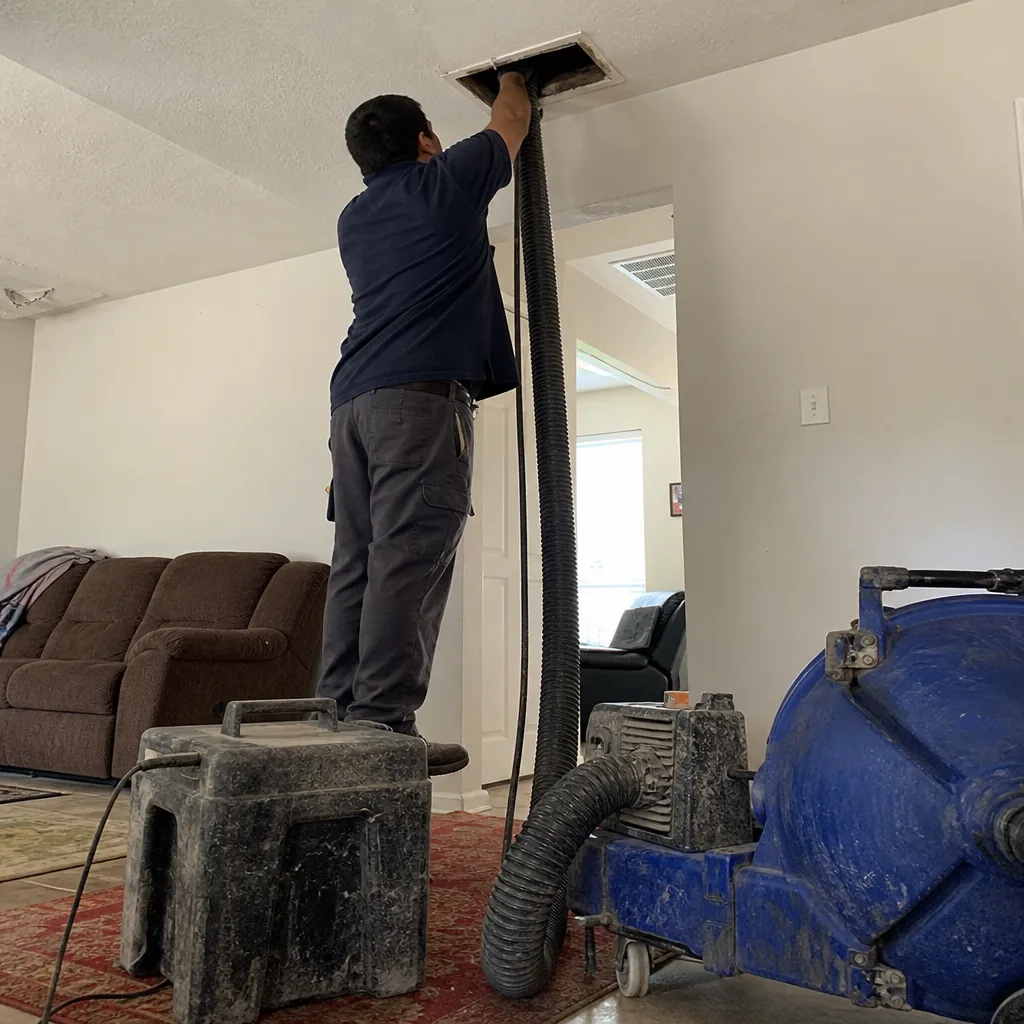
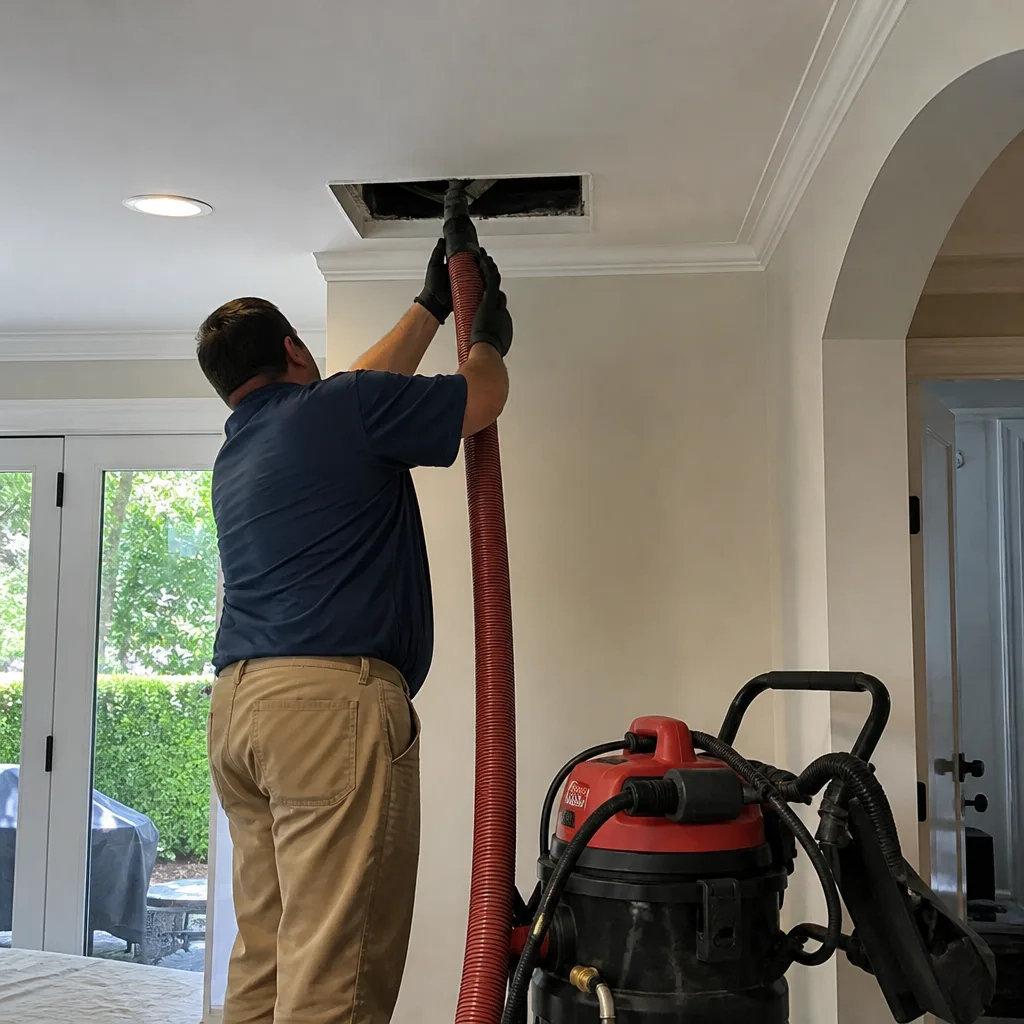
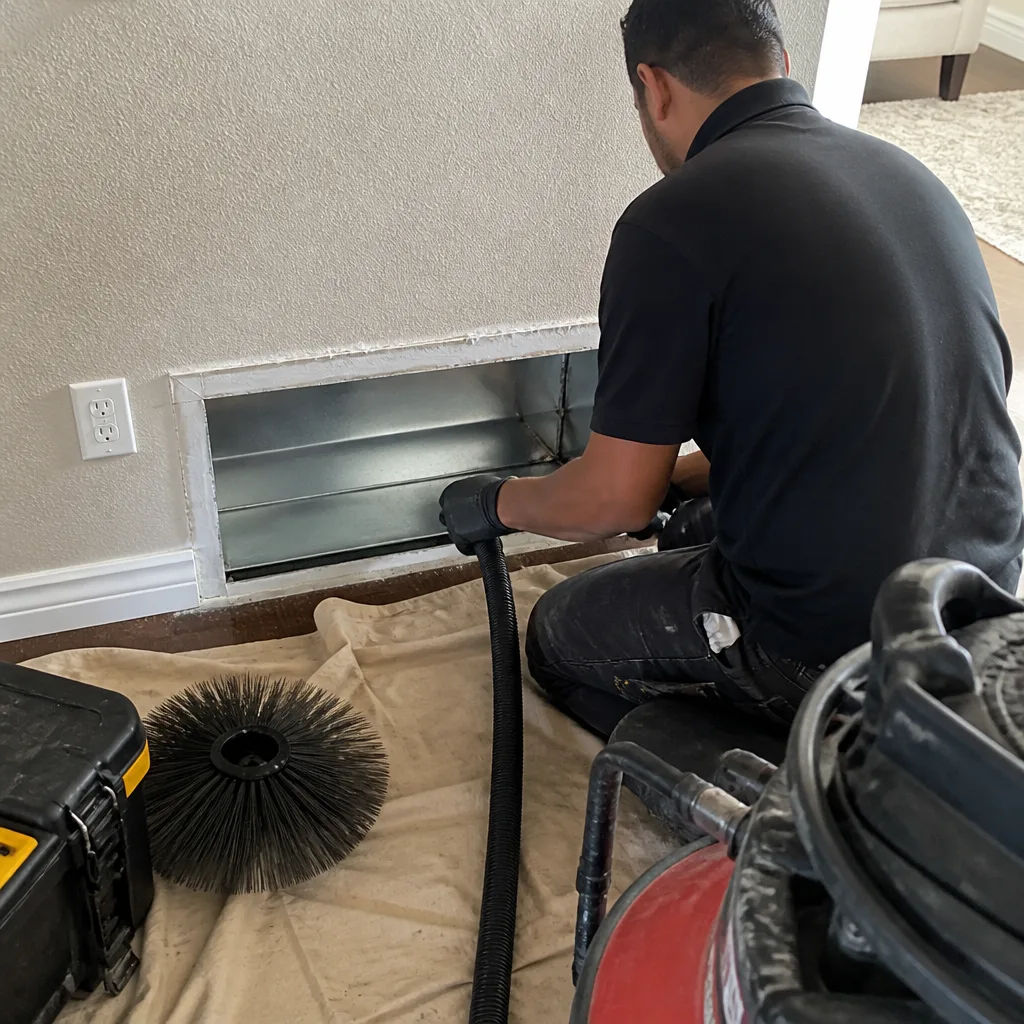
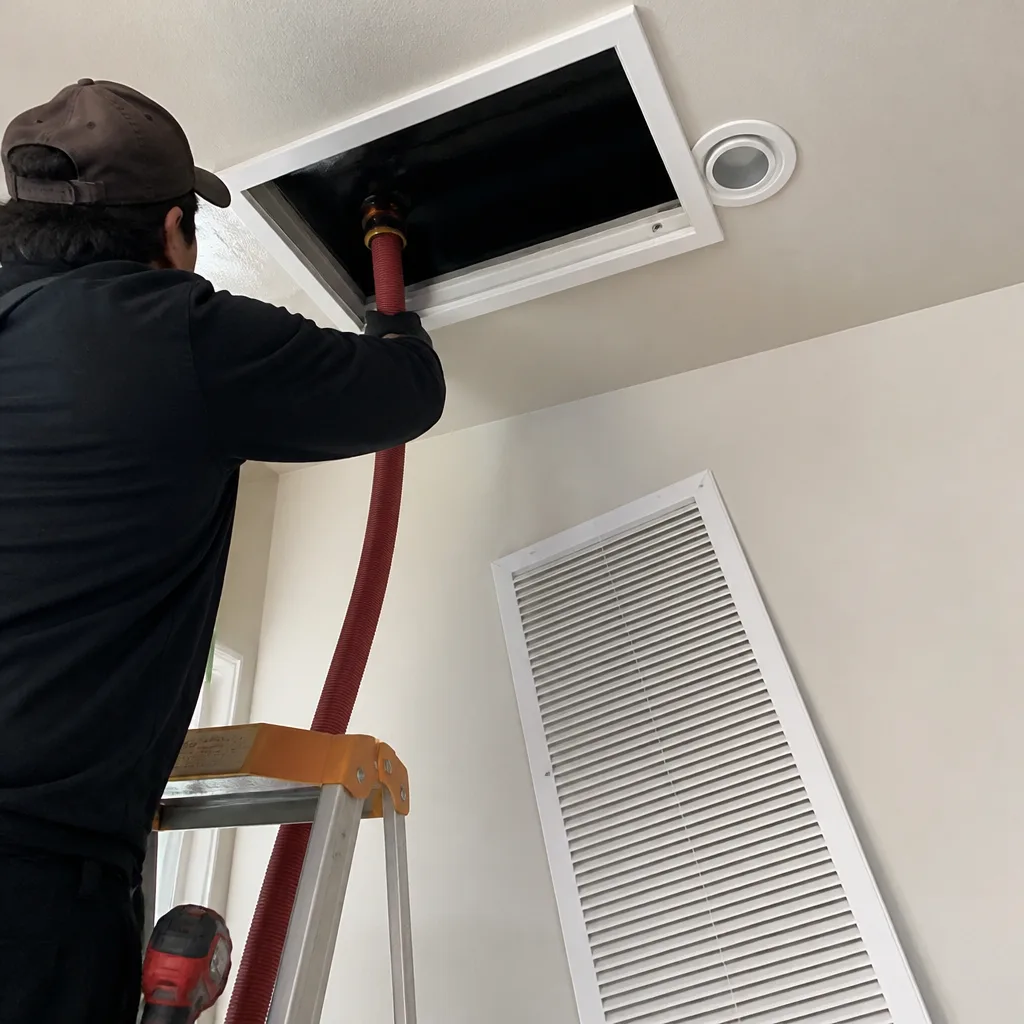
Cleaning itself uses negative-pressure extraction. A large vacuum unit, either truck-mounted or portable with Power from Rotobrush or Nikro equipment, connects to the duct system and creates sustained negative pressure in the run being cleaned. Mechanical agitation tools – rotating brushes, air whips, or pneumatic systems – move through the ducts and dislodge material from the walls. The negative pressure continuously pulls that material out of the system and into the collection unit. Nothing re-enters the living space.
After the cleaning, we do a post-job inspection, photograph the same locations we photographed before, and show you the comparison. That’s your proof the work was done. If you request it, we’ll walk you through the photos so you can see exactly what was removed.
The whole process runs about two to four hours for a typical Austin single-family home, depending on the number of systems and runs. For systems with multiple returns and long runs – common in two-story homes throughout neighborhoods like Mueller and Allandale – the job takes longer because there is more duct to clean.
One thing we will not do is quote you a per-vent price. That pricing structure encourages technicians to find problems that aren’t there. We quote one price for the whole system, in writing, before work starts, and that’s what you pay.
Common Mistakes to Avoid
- Believing a shop vac cleans ducts because it “sounds powerful.” A shop vac’s suction is designed for concentrated pickup at close range, not for pulling air through a 20-foot duct run with bends and transitions. The physics do not support the aspiration.
- Using a blower to “blow out” the ducts. Dislodging debris without immediate collection sends it into the living space or deeper into the system. You’ve manufactured an air quality problem while thinking you solved one.
- Buying cheap fiberglass filters to “save money” on replacements. A $3 filter that catches large lint but passes fine dust is not doing the job your system needs, especially in Austin’s long cooling season. The filter is the cheapest air quality device in your home; don’t buy the one that doesn’t work.
- Ignoring the return side. Most homeowners check supply registers and forget the return entirely. The return is where air enters the system, and its condition determines what gets distributed throughout the house.
- Trusting a per-vent quote. If a company quotes you “$39 per vent,” you don’t know what the job costs until they count vents, and you’re inviting the upsell routine. Honest pricing doesn’t work this way.
- Waiting until there’s a problem to look. By the time you can smell or see an indoor air quality issue, the duct system has been distributing the problem for months. The phone camera inspection costs you twenty minutes and no money.
- Assuming construction dust “will just work its way out.” It won’t. Construction dust is heavier than household dust, settles quickly, and resists resuspension. It sits in your ducts until something mechanically removes it.
When to Call a Professional
You should call a professional air duct cleaner in Austin when the problem is beyond the reach of the tools you own, which is usually the case when the concern is inside the duct runs rather than at the register faces. That’s the case after renovation, when you see visible mold or staining, when someone in the home has persistent respiratory symptoms, or when the system simply hasn’t been cleaned in five years. You should also call if you want the job documented – before-and-after photos, written pricing, and a written guarantee on any repair work. Air duct repair in Austin is not a DIY project under any circumstances. Linden Air Duct Austin offers free estimates throughout the Austin area – call (940) 461-7203 to schedule one.
Frequently Asked Questions
Professional air duct cleaning in Austin typically costs $400 to $650 for a whole-system cleaning of a single-family home, depending on the number of returns, the length of the runs, and the system configuration. You’ll find lower per-vent quotes that balloon into similar or higher totals once the technician counts vents and finds “additional problems.” At Linden Air Duct Austin, the price is written upfront, before any work begins, and it’s one flat price for the whole system. Call (940) 461-7203 for an exact quote – estimates are free.
You can clean the register faces, return grilles, and the first few inches of duct you can reach, but a shop vac cannot generate the negative pressure required to clean the full duct runs. Any debris you dislodge without proper collection will resettle deeper in the system or circulate through your house. DIY cleaning is maintenance, not remediation.
For most Austin homes, professional cleaning every three to five years is appropriate, with the shorter interval applying to homes with pets, high pollen exposure, or proximity to construction. Homes where the system hasn’t been cleaned in five years or more should be inspected and likely cleaned, because Austin’s long cooling season moves more air and more particulate through the ducts than cooler climates.
Cheaper quotes in Austin usually come from per-vent pricing, which starts with a low teaser rate and escalates once the technician is standing in your home. The goal is to get a van in the driveway, at which point the price changes. Honest pricing quotes one system price upfront, in writing. If a quote seems dramatically cheaper, ask whether the quoted price is per vent or per system. The answer tells you a lot.
Ask for before-and-after photographs of the same locations. A professional job should include visual documentation of the duct interiors before and after cleaning. At Linden Air Duct Austin, that documentation is standard practice, not an extra. If a company refuses or says photos aren’t necessary, treat that as a red flag.
Duct cleaning can reduce the amount of particulate that resuspends into the air during cooling cycles, which may help with allergy symptoms caused by dust, pollen, and pet dander. It is not a substitute for proper filtration, source control, or medical treatment. The benefit is most noticeable when the system is heavily loaded and the cleaning removes material that has been accumulating for years.
The Bottom Line
DIY duct maintenance is worth doing: change your filters, clean your register faces, inspect your system with your phone, and stay honest about what you’re seeing. What DIY cannot do is clean the inside of your duct runs, and pretending otherwise is how Austin homeowners spend the same money twice. If the system has been professionally maintained and looks clean, keep doing the DIY work. If it hasn’t, and it doesn’t, the professional route costs about the same as three years of DIY supplies and leaves you with an actually clean system. For more guides & resources, see our blog. The decision isn’t a matter of opinion. It’s a matter of looking, and then being honest about what the looking shows.
Linden Air Duct Austin provides dryer vent cleaning in Austin and full air duct services with written pricing, documented work, and the 365-Day Done Right Promise on every job. Serving Austin homeowners since 2004.
Written by Marcus Veale, Owner at Linden Air Duct Austin, serving Austin since 2004.
See the difference
 Before
 After
After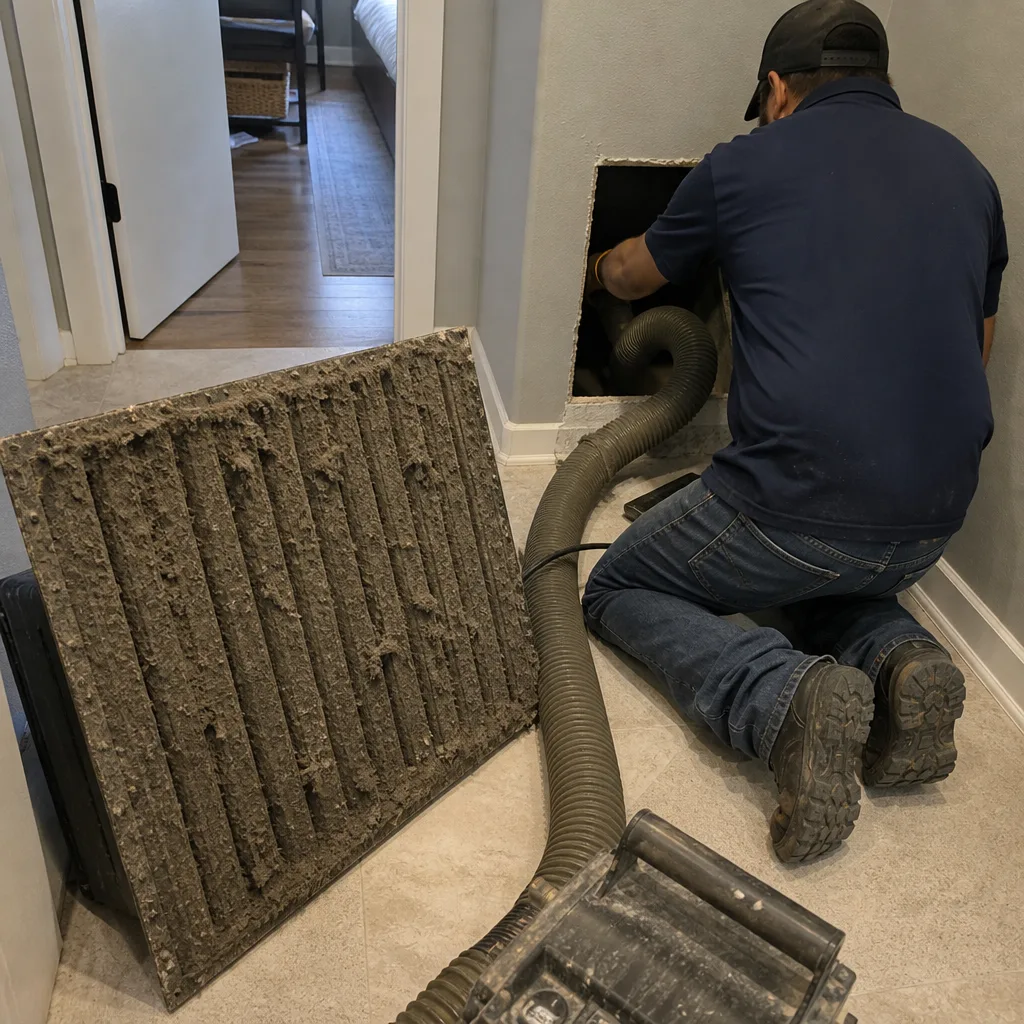 Before
 After
After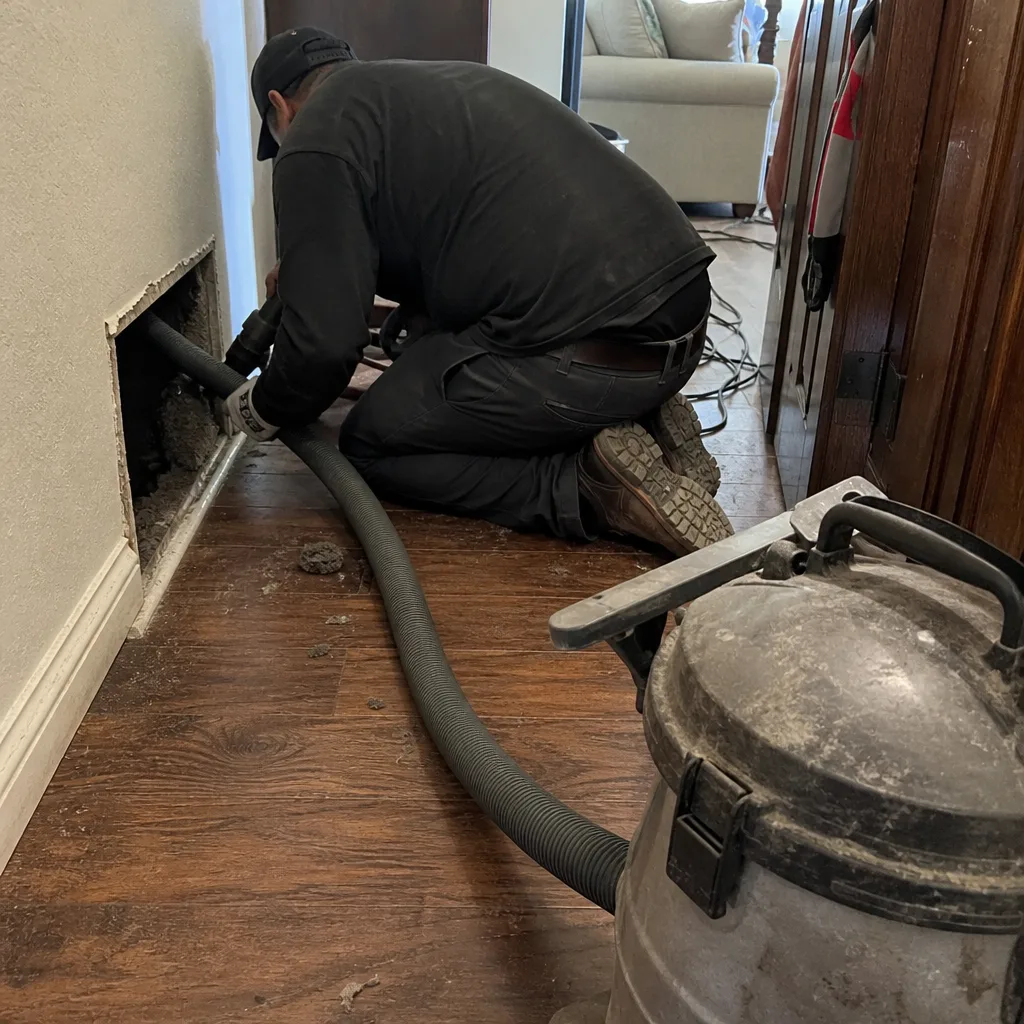 Before
 After
After